
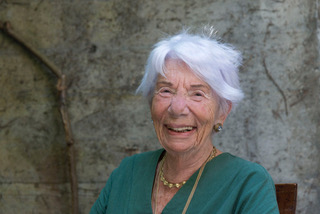
Julia Pestalozzi (January 16, 1934 – February 18, 2026)
Julia Pestalozzi first encountered the EFPP in 1993 at a scientific conference on the topic of “psychotic states” and was inspired by its openness, sincerity, and respectful curiosity. This marked the beginning of her decades-long commitment and the many friendships we remember with deep gratitude on the occasion of her passing.
The European Union had just been founded, internal borders had become permeable to the free movement of people, and psychotherapists from Central and Eastern European countries were increasingly expressing a desire to participate in professional exchanges with their Western colleagues. This new beginning following the years of the Cold War held special, personal significance for Julia Pestalozzi against the backdrop of her own escape from Hungary.
With enthusiasm and great diligence, she set about establishing a German-speaking Swiss EFPP section, which was founded in Basel in 1995 with a ceremonial event. Numerous colleagues joined this section and soon formed an active movement with several working groups organizing professional conferences, stimulating the emergence of sister organizations in other parts of the country, and ultimately networking within EFPP Switzerland.
In 1996, Julia Pestalozzi initiated the planning of a training institute. After suffering a professional disappointment, she invited a few like-minded individuals to first envision an ideal institution—initially without any constraints of what was feasible—and then to bring it into concrete form. It was to be a house of diversity, where people would learn, discuss, and debate together, and where the achievement of goals would be celebrated as her cultural background dictated: with music and a lavishly set table. With her forward-looking perspective, she transformed the setback she had experienced through an exemplary creative process. The training institute was founded in 2002 and achieved considerable success and prestige in the 24 years since its inception.
At the European level, Julia Pestalozzi served as EFPP Honorary Secretary from 1999 to 2003 and shaped this essential organisational role through her unique, friendly manner. She welcomed delegates from new member countries in her inimitable way.
Julia Pestalozzi’s personality proved extraordinarily enriching during this pioneering phase. She found common ground even where entrenched positions had developed over the years, and her infectious optimism was a breath of fresh air in the professional landscape. Her interest in others—their cultures and the realities of their lives, her hospitality, her experience with migration, and her multilingualism made enriching personal encounters possible, from which something new and shared could emerge. She was European through and through. She entrusted her colleagues with responsibilities early on. She was an inspiring instigator who passed down her leadership role after just a few years, thereby fostering a vibrant sense of generativity within her sphere of influence.
Even though she repeatedly focused on building organisational structures at the international, national, and local levels, her true, lifelong interest lay in personal encounters with her patients. Through her publications, particularly in “Psychotic Transference as an Opportunity”*, she allowed us to share in this. Her solidarity with the suffering of her fellow human beings touched many of us, even in the online meetings of the EFPP large group, in which she regularly participated in recent years on the topics of the pandemic and the war in Ukraine. She continued her own practice until shortly before her 91st birthday, and her intervision group met at her home on the very eve of her death!
We owe her a great deal; her memory will live on in us and in our organisations!
Rudolf Stefan Balmer, Julia Besch, Tibor Klaber, Joachim Küchenhoff, Herbert Lorenz, Peter-Christian Miest
_________________
*Julia Pestalozzi, 1996: Psychotic Transference as an Opportunity. Psychotherapy of a Dysmorphophobic Adolescent. Kinderanalyse, Vol. 4, No. 1, pp. 1–54